Strength Calc
// Chart-Based Training Weight & Volume Calculator
Enter Your PRs
Bench Press
lbs
Deadlift
lbs
Squat
lbs
Military Press
lbs
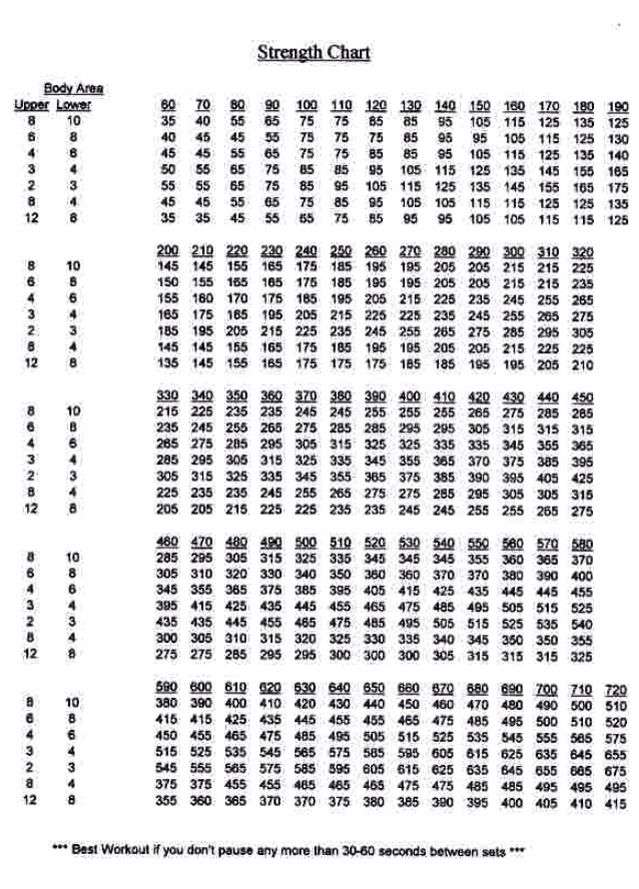
// How It Works — Enter your 1-rep max (PR) per lift. The calculator maps your PR against
the Strength Chart using piecewise linear interpolation across all data points, then outputs
the recommended training weight for each of the 7 set/rep schemes.
// Upper / Lower — In each scheme (e.g. 8 × 10), the first number is your rep count for upper body lifts (bench, military press) and the second is your rep count for lower body lifts (squat, deadlift). Both use the same training weight — the chart gives one weight per PR per scheme.
// Range — Chart covers PRs from 60 to 720 lbs. Values outside this range are clamped. Weights rounded to nearest 5 lbs.
// Upper / Lower — In each scheme (e.g. 8 × 10), the first number is your rep count for upper body lifts (bench, military press) and the second is your rep count for lower body lifts (squat, deadlift). Both use the same training weight — the chart gives one weight per PR per scheme.
// Range — Chart covers PRs from 60 to 720 lbs. Values outside this range are clamped. Weights rounded to nearest 5 lbs.
Bench Press // Training Prescription
Deadlift // Training Prescription
Squat // Training Prescription
Military Press // Training Prescription
Scheme Reference Guide
8 × 10
8 reps (upper) / 10 reps (lower)
High volume, moderate load.
Hypertrophy
High volume, moderate load.
Hypertrophy
6 × 8
6 reps (upper) / 8 reps (lower)
Volume + strength crossover.
Hypertrophy
Volume + strength crossover.
Hypertrophy
4 × 6
4 reps (upper) / 6 reps (lower)
Lower volume, heavier load.
Strength
Lower volume, heavier load.
Strength
3 × 4
3 reps (upper) / 4 reps (lower)
Heavy strength territory.
Heavy Strength
Heavy strength territory.
Heavy Strength
2 × 3
2 reps (upper) / 3 reps (lower)
Near-max. Peaking protocol.
Power / Peak
Near-max. Peaking protocol.
Power / Peak
8 × 4
8 reps (upper) / 4 reps (lower)
Strength-focused high reps upper.
Strength Volume
Strength-focused high reps upper.
Strength Volume
12 × 8
12 reps (upper) / 8 reps (lower)
Max volume, conditioning.
Endurance
Max volume, conditioning.
Endurance
*** Best workout if you don't pause any more than 30–60 seconds between sets ***
Source Chart Reference